
Chiropractic

Chiropractic
What Does a Chicago Chiropractor Do?
Neck pain, back pain, and headaches can all result from injuries to the spine. Stress from tension, anxiety, accidents, overexertion and poor posture are all things that can cause inflammation, injury, or spine and joint degeneration. These changes can happen quickly with an injury or over time with repetitive stress. For these types of spinal injuries as well as muscle injuries, a chiropractor is an excellent choice for patients seeking conservative, drug-free care for their pain.
A chiropractor, or Doctor of Chiropractic (DC), is someone who has completed a nationally accredited, four-year doctoral graduate school program. The program’s curriculum must include a minimum of 4,200 hours of classroom and laboratory education as well as a clinical internship, which is generally equivalent to the classroom hours required by allopathic (MD) and osteopathic (DO) medical schools. Further, a chiropractor in Chicago need to have completed the National Board Exam and be licensed to practice by the Illinois Department of Financial and Professional Regulation. To learn about our Chiropractic services and to see if you could be a candidate for chiropractic therapy, contact us today.

Methods of Chiropractic Care Tailored to You
As you may see in your search for a chiropractor to help you, there are many ways chiropractic is practiced and many variations among each type. The majority of Chiropractors you will find use their hands to adjust while some may use various instruments or other approaches. It all depends on the chiropractor’s philosophy. Here are just some of the methods chiropractors use to treat their patients
Philosophy Differences
- Subluxation based: treatment based on the correcting subluxations in the spine or neck only to alleviate pressure on nerves allowing body to express full potential
- Evidenced-based (treatment based on the outcomes of earlier treatment) and Research-based: (treatment based on research done by other chiropractors and professionals in the field)
Treatment Differences
Choosing Chiropractic Care Means Choosing Conservative Care First
Chiropractic care is a drug- and surgery-free option that focuses on improving joint mobility, muscle tone and function, and correcting the dysfunction that caused the injury or condition to begin with. When you want to go with a conservative care option before trying other treatments like painkillers or surgery, a chiropractor is a great place to start. For more information on choosing conservative care options first, please click on the tabs below.
Chiropractic vs. Medications
 Over-the-counter pain relievers like acetaminophen have minimal benefit to the patient, and stronger prescriptions can be addictive or even deadly. According to the CDC, opioid painkillers are the cause of three out of four prescription drug overdoses. You may have heard a lot in the news about the Nation’s Opioid Epidemic – which is true, but the underlying cause is really a Pain Epidemic and chiropractors are a great choice for patients seeking drug free relief. Additionally, painkillers only mask the pain, which can have a detrimental effect on patient recovery.
According to the American Chiropractic Association, “Prescription drugs that numb pain may convince a patient that a musculoskeletal condition is less severe than it is, or that it has healed. That misunderstanding can lead to over-exertion and a delay in the healing process, or even to permanent injury.”
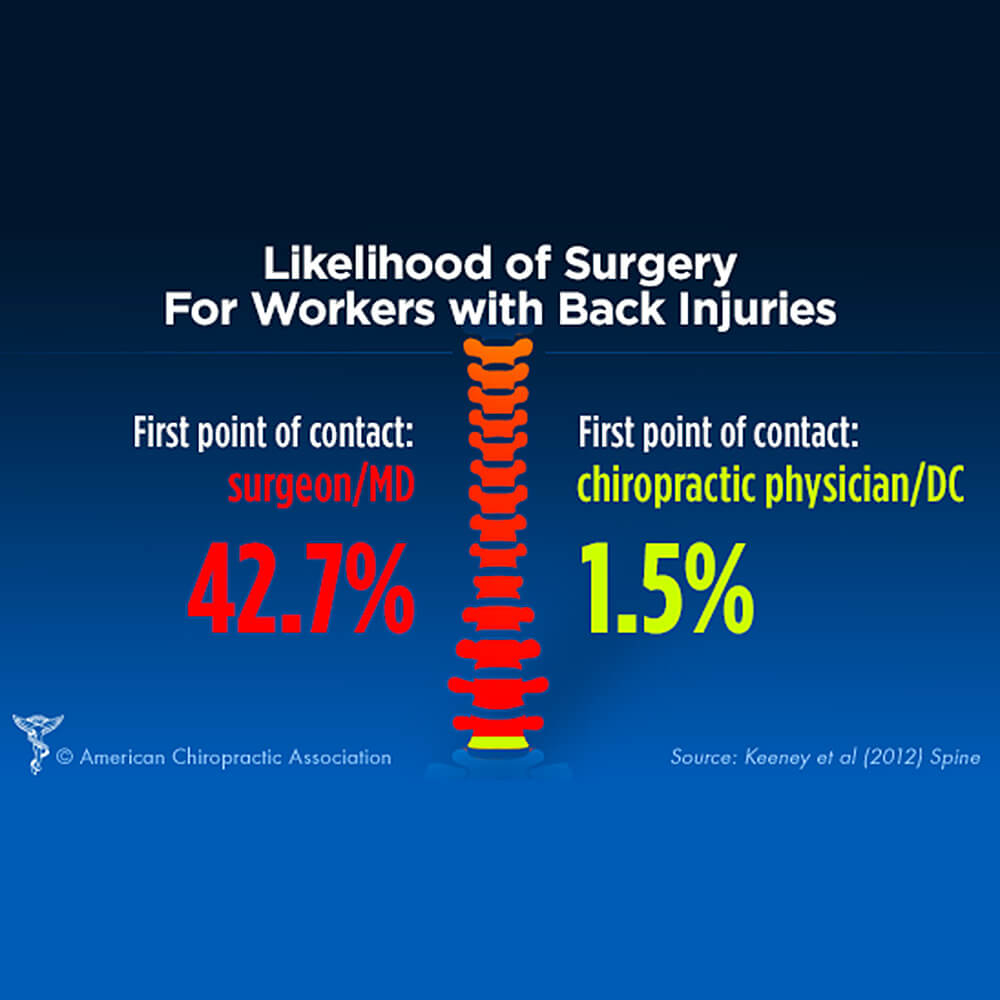 Chiropractic vs Surgery
 Chiropractic vs Surgery
In addition to the standard risks surgery poses such as infection, anesthesia complications, and blood clots, other well-documented risks specific to spinal injury include hardware migration (such as a screw breaking or a graft subsiding) and transitional syndrome (increased stress on segments next to where the fusion was performed), both of which may require additional surgery to remedy.
In fact, spine fusion surgery fails about 20% of the time (short-term), especially if the fusion involves three or more levels and rates of failure are typically reported even higher at the 5 and 10 year follow-ups (rates vary depending on study inclusion criteria and surgery performed) . This is a condition commonly known as “failed back surgery syndrome.” Other possible but rare complications with spinal surgery in the lower back include loss of bladder control and sexual dysfunction.

Chiropractic Care is Cost Effective
Studies have shown that chiropractic care has been a more cost effective option than medical doctors for many injuries stemming from workers compensation cases. The same research also revealed that the average number of lost workdays was lower for those receiving chiropractic care compared to those being treated by MDs. The results are clear: chiropractic care costs less than medical care and often puts people back to work sooner after an injury.
In fact, chiropractic care is so cost-effective that many employers would prefer that their insured employees take advantage of chiropractic before turning to other treatments. According to a study published in the Journal of Occupations and Environmental Medicine, “employers can save $1.65 in healthcare expenses for every $1 spent on a comprehensive employee-wellness program”. In a study of 2,000,000 chiropractic patients published in the American Health Policy Report in 1992 concluded that “chiropractic users tend to have substantially lower total health care costs” and “chiropractic care reduces the use of both physician and hospital care”. In general, insured patients receiving chiropractic care cost their employers and health insurance companies less money, due to fewer surgeries, decreased needs for medical imaging, and fewer trips to the hospital to deal with their neck or back pain.
 Patient Satisfaction
 Patient Satisfaction
Chiropractic patients are not only satisfied with the lower cost of their care; they consistently report very high levels of satisfaction with their overall treatment plan and provider.
Some reasons given for the high degree of satisfaction include lower rates of surgery, fewer hospitalizations, and fewer prescribed pharmaceuticals to treat the patient’s pain. Patients seeking an alternative treatment plan via chiropractic care are usually satisfied with what they find.
 Chiropractic Care is Safe
 Chiropractic Care is Safe
Chiropractic care, including chiropractic adjustments of the cervical spine (neck), is one of the safest therapies for back and neck pain, joint pain and other types of musculoskeletal complaints. Chiropractic care also carries significantly less risk than medications and surgery.
The ACA likes to explain the risk of chiropractic treatment this way: “to put this risk into perspective, if you drive more than a mile to get to your chiropractic visit.”
Chiropractic Care is Based on Sensible Scientific Principles and Evidence-Based Medicine
Today, chiropractic ranks as the third-largest health care profession and is the most widely used drug-free treatment in the world. Ravenswood Chiropractic & Wellness Center is an evidenced-based care chiropractic practice. This means that we only use procedures that are backed up by research and clinical evidence supporting their efficacy in resolving specific issues.
Over the past 10 to 15 years, evidence-based chiropractic care such as the care we offer has increased in popularity. This is due in part because of its success in finding the proper course of treatment to help the patient’s pain.
Through evidence-based care and additional research, chiropractic care has been proven to be effective in the treatment of low back pain, neck pain, extremity conditions, intramuscular conditions, and even headaches.

We use the same methods that researchers use.
We also record our patients’ initial condition and progress to make sure we see continual improvement. One way we accomplish this is to use surveys such as the Disability Index and Visual Pain Analog Scale to monitor progress. These surveys are one difference patients will notice between our practice and a non-evidence based practice.
Chiropractic care is not just an adjustment, it is a safe, cost-effective approach to pain, injury and well being.
To learn more about chiropractic care, call us at 773.878.7330. Our expert team members are happy to answer any questions you have.
We are located in Andersonville on Chicago’s Northside near Lincoln Square.
Also Related…

Chiropractic Care During Pregnancy
Find out all about the pain-relieving benefits of chiropractic care during pregnancy.

Chiropractic Care for Children
Chiropractic care isn’t just for grown-ups – check out all of its benefits for children of all ages, from newborns to 18-year-olds.

Chiropractic Care for Sports and Fitness
Learn how Chiropractic Care can help boost performance, prevent injury, and resolve current sports injuries.

Selective Functional Movement Assessment
Learn about the SFMA diagnostic system and how it’s used to get you results.
References and Additional Resources
i Delaney PM, Fernandez CE. Toward an evidence-based model for chiropractic education and practice. J Manipulative Physiol Ther. 1999;22:114–118.
ii J Evid Based Complementary Altern Med. 2012 Dec 28; 18(1): 75–79. Published online 2012 Sep 3 Ibid.